A few retailers are now offering free or heavily discounted power during the middle of the day, typically 10am to 3pm, to soak up the excess solar being pumped into the grid during peak generation hours. For households with high daytime loads, it's a genuine opportunity to reduce bills.
But we've started seeing a problem.
Some people are trying to get as much out of those free hours as possible. Running the dishwasher, washing machine, dryer, hot water system, pool pump, and air conditioning all at the same time. In some cases, EV charging on top of that. The instinct makes sense. If the power's free, use it. The issue is that your service connection has limits, and those limits aren't printed on anything you'd think to look at.
What We've Been Seeing on Site
We've had a few calls recently about tripped safety devices and unusual burning smells at meter boxes. When we've gone out to investigate, the culprits have been consistent: blown primary fuses, and in a couple of cases, melted Energex sealed isolation links.
The pattern we're seeing most often is homes that have a battery system, solar, and an EV charger. During the free power window, the battery is charging, the EV is charging, and the rest of the house is running at full tilt at the same time. That combination stacks up fast. It's not unusual to see 20 to 30 kilowatts of simultaneous demand on a service connection that was never sized for it.
The isolation link is the fused connection between Energex's network and your switchboard. It's sealed, Energex property, and it's sized to match your approved service capacity. It's not designed to handle sustained loads well above that capacity. When it melts, it's not just an inconvenience. It means the whole property loses supply until Energex attends, and depending on the damage, that can take a while.
Primary fuses at the pillar or pole tell a similar story. They blow when the load is sustained and excessive. Again, Energex attendance required.
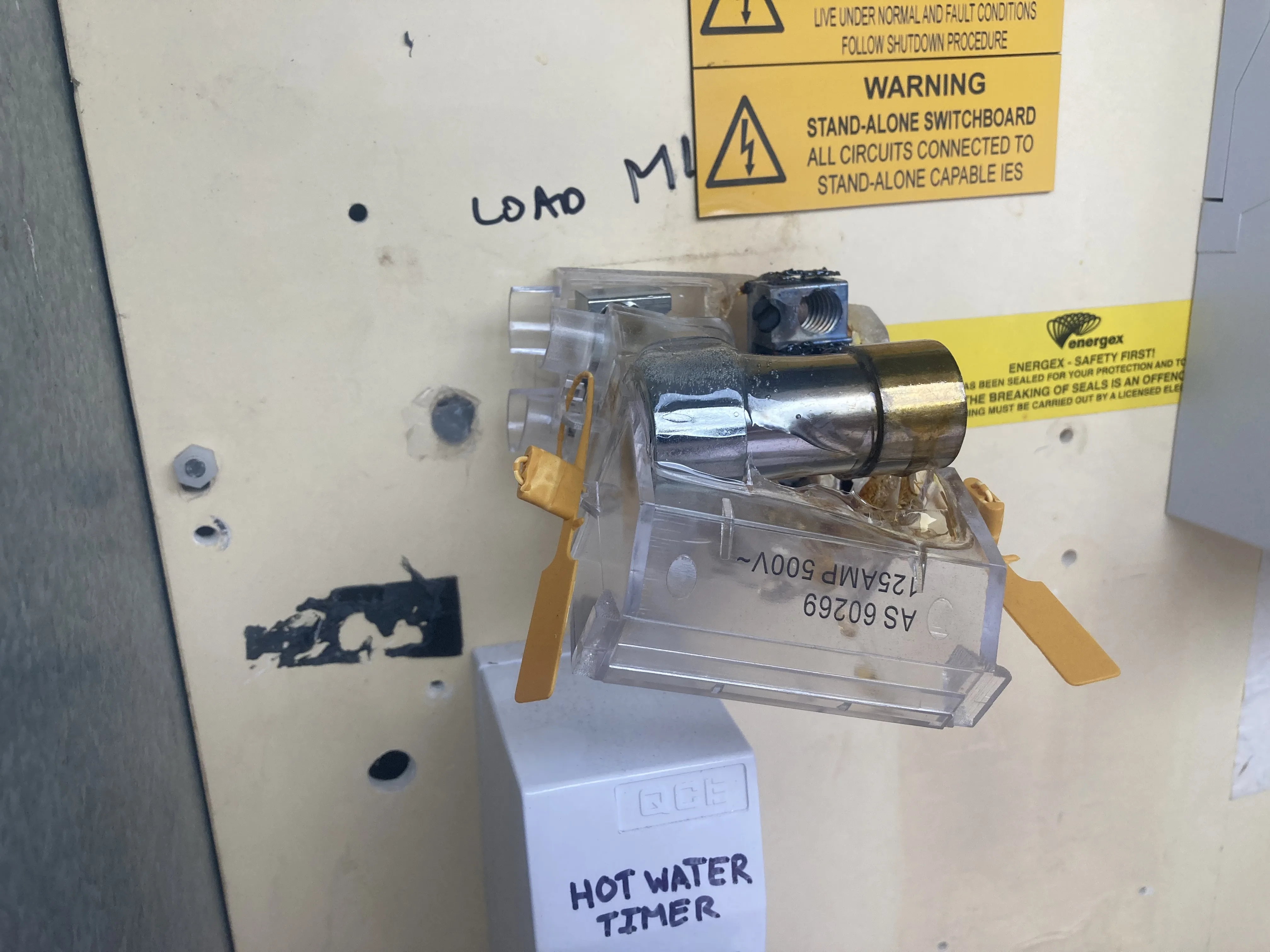
A melted 125A Energex sealed isolation link. The burn damage was caused by a combination of sustained overload during a free power window and a slightly loose terminal. Either one alone might not have done it, but together they generated enough heat to melt the housing.
Don't investigate it yourself
The isolation link is Energex sealed infrastructure. If you suspect damage, call us or call Energex directly. We can assess the switchboard side, but anything upstream of the meter is Energex's work.
The Actual Limit Nobody Tells You About
A standard residential service connection is typically rated at 63 amps per phase. On a single phase property, that's roughly 14.5kW of continuous draw. Run enough appliances simultaneously and you'll exceed it, particularly during those free power windows when everyone is doing the same thing at the same time.
The problem with the solar, battery, and EV charger combination is that all three can be drawing from the grid at once. The battery charging from the grid, the EV charger pulling 7kW or more, and the house load on top of that. None of those three things alone would cause an issue. Together, they can easily push a service connection past its rating for an extended period.
Grid import limits
Most modern battery and EV charger systems allow you to set a grid import limit. This caps how much power the system can draw from the grid at any one time. We configure this on every install we do. If yours wasn't set up that way, or if you've added equipment since the original install, it's worth getting that checked.
If You Have Solar, a Battery, and an EV Charger
The combination itself is fine. We install all three together regularly. The issue is whether the systems are configured to work together rather than just independently.
When we commission a system that includes a battery and an EV charger, we set grid import limits so the combined load stays within what the service connection can handle. If your system was installed piecemeal over time, by different installers, there's a reasonable chance that coordination hasn't happened.
Signs to look out for:
- Your main switch has tripped during the middle of the day when you're running a lot of loads
- You've noticed a burning smell near the meter box
- Your supply has dropped out and Energex had to attend
- You added an EV charger or battery after your original solar install without a full system review
If any of those apply, it's worth having someone look at how the systems are configured together, not just whether each individual piece is working.
A New Problem That's Going to Get More Common
This is a direct consequence of free midday power tariffs becoming more widespread. The grid benefit is real. Spreading load across the solar peak is genuinely useful for the network. But a lot of households now have enough equipment to overload their service connection if everything runs at once, and most people have no idea where that ceiling is.
We expect to see more of this as more retailers roll out similar offers and more homes add batteries and EV chargers to existing solar systems. Getting your grid import limits configured properly is the fix. It doesn't cost much and it stops the problem before it starts.
Not Sure if Your System Is Configured Right?
If you have solar, a battery, and an EV charger and they weren't all installed at the same time, get in touch. We can check the grid import configuration and make sure everything is working together properly.
Get in TouchAbout the Author
Director, Flux Electrical Systems
Licensed electrician and founder of Flux Electrical on the Sunshine Coast. 15+ years in solar and battery contracting. Electrical Worker Licence 121082. SAA Accredited for solar, on-grid batteries, and off-grid systems.